AVE3
Advanced Video Extensometer
Contact Our Sales Department.
Please complete the form below and we will be happy to contact you with a response. Our typical response time for an online request is within 1-2 business days. For a faster response, please call +1-800-473-7838.

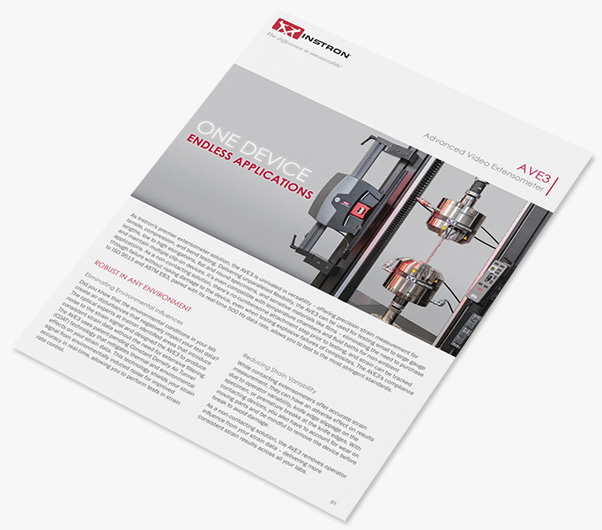
As the premier extensometer solution, the AVE3 is unrivaled in versatility — offering precision strain measurement down to 1 micron accuracy for tensile, compression, and bend testing. Delivering unparalleled flexibility, the AVE3 can be used for everything — small to large gauge lengths, low to high elongations, sensitive materials like films,
explosive failures of composites, and even non-ambient testing in a chamber or a fluid bath. The AVE3's compliance with ISO 9513 and ASTM E83 means you can reliably test to any standard with one device, eliminating the need to purchase and maintain multiple clip-on devices.
Designed for Accuracy
Eliminate Environmental and Operator Influences on Results
CDAT Airflow Technology Patent Pending
Did you know that the environmental conditions in your lab create air disturbances that negatively impact your device's performance? Thermal and environmental disturbances can worsen device accuracy by up to 5 times when compared to the performance you would see under perfect lab conditions. These disturbances can be caused by normal laboratory activity such as people walking by the device, operators having a conversation nearby, or an HVAC system turning on. Instron's AVE3 features patent-pending Constant Density Air Tunnel (CDAT) airflow technology that shields your test space while mitigating any thermal or environmental effects, giving you accurate and repeatable results every time.

Non-Contacting Solution
The AVE3 eliminates the effect of operator attachment on your strain data, producing more consistent and repeatable results. By measuring strain without contact, the AVE3 eliminates the cumbersome attaching and detaching required with clip-on devices, in addition to preventing premature damage to the specimen from knife edges — optimizing throughput and ensuring the most accurate results.
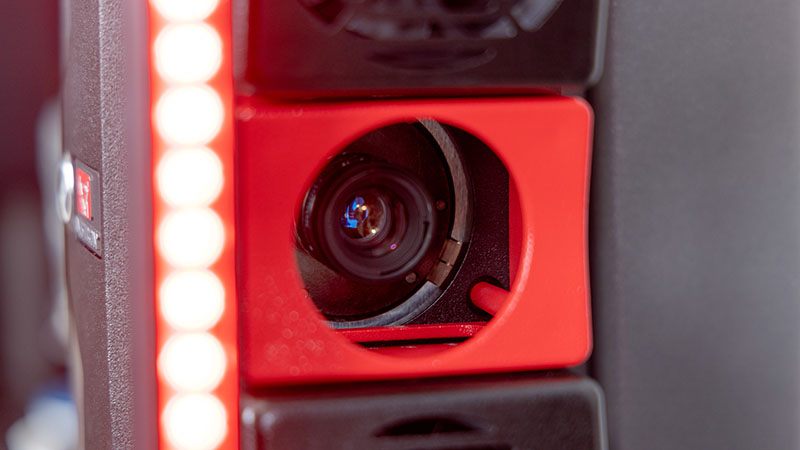
Dynamic Cross-Polarized Lighting Patented
No two labs have the same lighting conditions, and lighting can change throughout the day, which can lead to variation in results. To ensure the AVE3 always sees the same image, Instron uses a patented cross-polarized lighting system that dynamically adjusts to ensure your markings are perfectly illuminated for consistent results on every test.
One Device
Endless Applications
The AVE3 can measure both modulus and strain to failure for almost any application, including static tensile, flexure, and compressive testing for flat and round specimens. Measurements can be collected at ambient conditions or at high and low temperatures when using environmental chambers or fluid baths. Whether you're testing plastics, metals, composites, textiles, films, foils, elastomers, paper, components, or biomaterials, the AVE3 offers the versatility to meet evolving testing demands and the following standards.
Metal Standards
- ISO 6892, ASTM E8, JIS Z 2241, GB 228.1
- r-Value (AverEdge32 Recommended): ISO 10113, ASTM E517, JIS Z 2254, GB/T 5027
Plastic Standards
- ISO 527-2, ASTM D638, JIS K 7161-2, GB/T 1040.2
- Flexural Tests: ISO 178, JIS K 7171, GB/T 9341
Composite Standards
- ISO 527-4/5, ASTM D3039, GB/T 3354
Elastomer Standards
- ISO 37, ASTM D412, JIS K 6251, GB/T 528
Film and Foil Standards
- ASTM E345, ASTM D882, GB/T 1040.3

Enhanced Control
Streamlined operator controls, integrated directly in Bluehill Universal software, and enhanced controls allow you to set preferences for when the light bar and fans are on.

Data Rate
On-board measurement technology processes data in real-time (500 Hz), and is capable of meeting strain control requirements.

Quick Mount
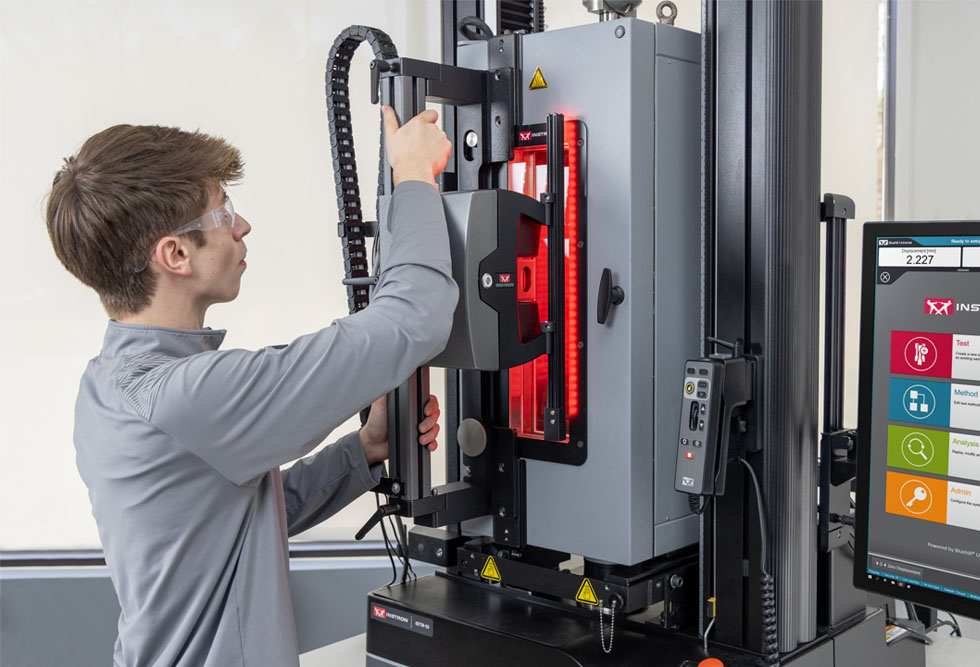
Easily mounts on nearly any Instron universal testing system and temperature chamber.

Automation Ready
Easily integrates with automation solutions for streamlined, high throughput strain measurement.
Smarter
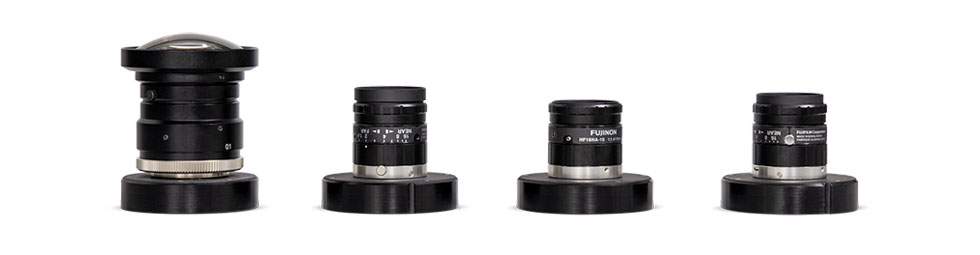
Lenses are configured and factory calibrated for your unique test setup. Aperture and focus settings are locked to remove any variability of operator influence. Each lens is programmed with an identification number, which allows the test system to automatically recognize the device through a kinematic connection. This new connection method guarantees a repeatable placement of the lens. The AVE3 also uses a simplified calibration plate that can clip directly onto your specimen with your load string intact, making it easier to perform periodic calibration checks to ensure it's dialed in and ready for testing.
Available Lenses
- 35mm (Short Field of View) — suitable for low-strain materials such as
composites, metals, and rigid or filled plastics. - 16mm (Standard Field of View) — suitable for materials such as plastics, metals,
sheet metals, and foils. Preferred lens for metals customers requiring strain rate control and
average transverse strain measurement (AverEdge32). - 6mm (Extra-Long Field of View) and 9mm (Long Field of View) — suitable for materials
with high elongations such as rubbers, elastomers, films, and some plastics.
Note: When selecting your lens, ensure you know your minimum and maximum gauge length requirements as well as total elongation of the range of specimens you plan to test.
Strain Control
Real-Time Data for Responsive Strain Rate Control
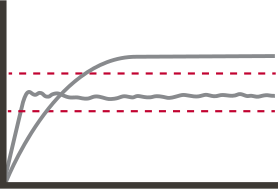
With the new AVE3, you're now able to perform testing that requires strain control, including ASTM E8 and ISO 6892. Between the advancements in accuracy and a data capture rate of 500 Hz, the AVE3 delivers rapid insights that allow the testing system to respond in real-time to changes in strain rate — ensuring you have repeatable and comparable results that comply with testing standards.
Advanced Capabilities
Optional Add-Ons
AverEdge32 ™
Advanced Averaging Transverse Strain Measurement for Sheet Metal
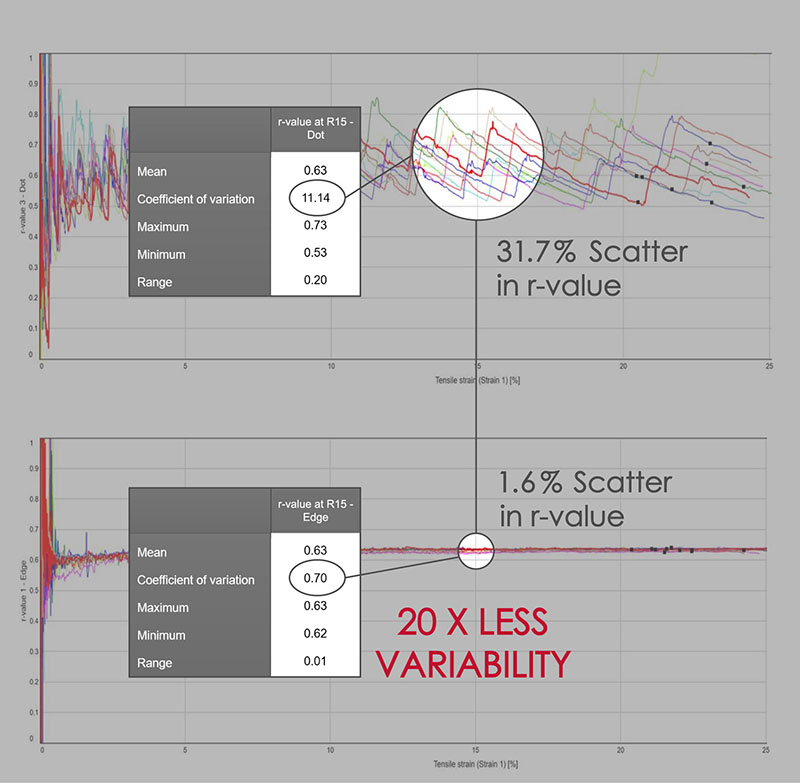
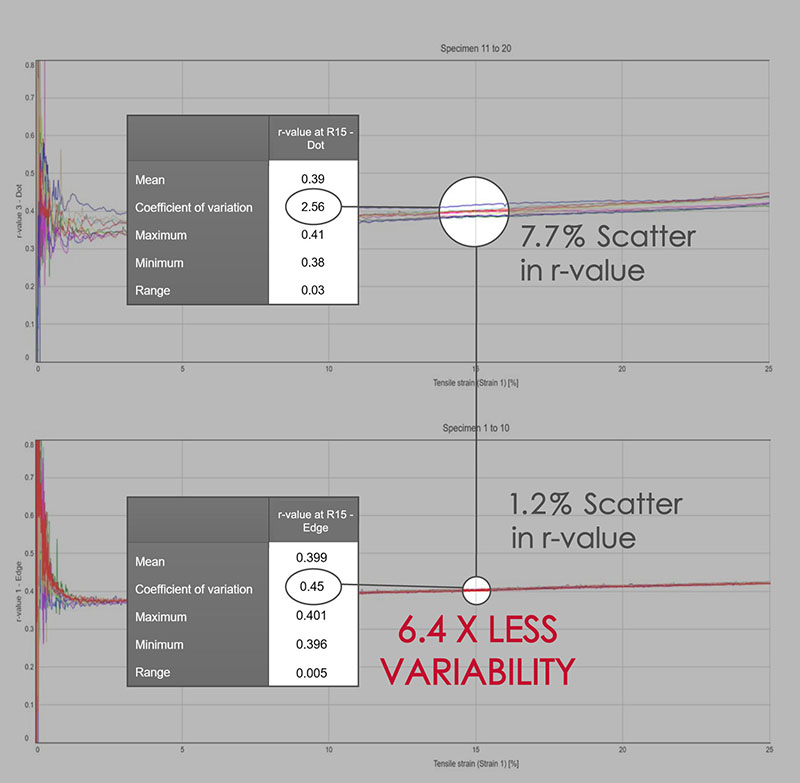
AverEdge32 is an optional advanced feature of the AVE3 that utilizes edge-detection technology to simultaneously measure transverse strain at 32 locations along the specimen gauge length. It then averages them in real time, resulting in a smooth and repeatable transverse strain value, which is essential to calculating the r-value of sheet metal.
Features
- Real-time transverse strain, averaged from 32 gauge widths, provides repeatable transverse strain with even the most demanding materials
- Improved results repeatability, reducing or eliminating the need to perform retesting
- Edge detection eliminates the need for transverse marks
- Exceeds the requirements of ISO 10113, ASTM E517, JIS 2254 & GB/T 5027 for plastic strain ratio (r-value)
r-Value Comparison
Single Gauge Width vs. AverEdge32 Technology
5000 Series Aluminum
6000 Series Aluminum
Digital Image Correlation
Optional Add-On for Full-Field Strain Mapping
Digital image correlation (DIC) is an optical technique that compares images of a tested specimen's surface to generate full-field strain and displacement maps. It creates pictures that can be used to visualize strain and displacement over the full two-dimensional surface of the test specimen.
- View materials testing phenomena, such as discontinuous yielding, localized necking, and more
- Analyze strain and displacement on the flat surface of a part or component where traditional extensometers are impractical
- Visualize and detect cracks that are not visible to the eye
- Check specimen preparation techniques by comparing one specimen to the next
- Check for standards compliance by identifying localized strain that falls outside of the standard gauge length
- Visualize the side profile of a flat flexure or compression specimen to observe strain behavior
- DIC software communicates directly with Bluehill Universal for easy transition from test to data review
Unparalleled Performance
Latest generation CDAT technology for up to 5x improvement in accuracy
(Compared to video extensometer without CDAT technology)

Dynamic Cross-Polarized Lighting
Data capture rate

6 mm, 9 mm, 16 mm, and 35 mm focal length lens options for a field of view up to 685 mm
Strain Control Capable

AverEdge32 Compatible for Transverse Strain Measurement
Digital Image Correlation (DIC) Software Compatible
(Optional)
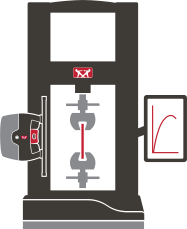
For static testing applications

Talk to an Instron Expert
Whether you are evaluating the AVE3 for a specific application or looking to replace multiple clip-on devices with a single versatile solution, our team is ready to help.